In June, this year,
Jubilee Mennonite Church in Winnipeg decided
to become welcoming and affirming—including conducting same-sex
weddings.
Jubilee is a dual
conference congregation, belonging to Mennonite Church Manitoba and the
Manitoba Mennonite Brethren Conference (MBCM).
For MC Manitoba,
their decision isn’t a problem; the denomination allows churches to decide
whether or not to be welcoming and affirming.
For MBCM, however, it
is problematic, especially around same-sex marriage and inviting LGBTQ+ people into positions of leadership. In September, the conference will
decide how to proceed about Jubilee’s decision.
I
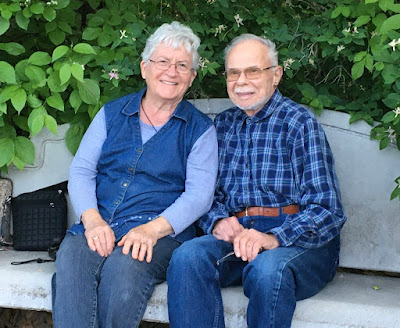
reached out to two long-time members of Jubilee who have roots in the Mennonite
Brethren conference—Hardy and Elfrieda Schroeder. What are their thoughts about
their church’s decision? What are their hopes for the future with the MB conference? Here is that
conversation.
Tell me about Jubilee
Mennonite Church and its decision to welcome and include LGBTQ+ people.
From our perspective, Jubilee has been welcoming, affirming and
inclusive of community and Indigenous people. Why should we hesitate to fully
accept LGBTQ+ people? And why does the MB Conference make an exception
here?
We believe that LGBTQ+ people should be welcomed
into full membership just like everyone else. As people who practice a
loving, intimate and committed relationship, they should be wholly 'eligible'
to be part of a like-minded church fellowship.
Hearing the personal stories of parents and their
children on “A Time to Listen” reinforced that for us.
For us this means that people, desiring a loving committed partner with whom to
share their life while having a same-sex orientation, are not
committing a sin.
As members of the MB conference, are you personally worried about how
the Manitoba MB Conference might react?
Our hope, of course, is that the Manitoba MB conference would give us their
blessing and leave it up to individual congregations to decide, just like they
did with the issue of women in ministry (which, in our opinion, took far too
long).
To us it seems the decision to accept women in ministry is similar to the LGBTQ+
issue, even though the conference claims it isn’t. It’s a way of interpreting
Scripture.
We would prefer that Jubilee not withdraw from the Manitoba MB
Conference. We also would not like for them to suspend our congregation from membership
in the Conference.
What has the Manitoba MB Conference said to you so far?
We were told, following a meeting between representatives from Jubilee
and the provincial MB conference, that they appreciate the process Jubilee went
through and they agree with much of our statement.
However, Jubilee’s
decision to marry same-sex couples and to invite people in same-sex
relationships to be in leadership positions is not consistent with the MB
Confession of Faith.
Unlike Mennonite Church Manitoba, the MB conference does not give
congregations space to adopt theology or practices that are outside the bounds
of the Confession of Faith. They view congregations that adopt such positions as
subject to disciplinary action.
In the case of Jubilee, this could involve the suspension of the
church’s membership in the conference.
This decision could be made by the MB conference at its AGM next March.
Another option is for Jubilee to withdraw from the MB conference—something we
wouldn’t like to do.
We appreciate membership in the MB conference, and our church has benefitted
from that relationship.
The MB community is part of who we are. We incorporate elements of both conferences
and their confessions of faith in our worship and life together. It would be
disappointing if this relationship ended.
Tell me about your backgrounds in the Mennonite Brethren conference.
We have been members of Winnipeg’s Jubilee Mennonite Church since 2009.
Before that we were members of the Kitchener, Ontario MB Church for 24 years.
At Jubilee, Elfrieda is encouraged to use her gifts in worship leading
and occasional preaching. This is a change from Kitchener, where her adult
Sunday school teaching was not affirmed by everyone. She could, however, be a
deacon—together with Hardy (although for some time women were not permitted to
serve communion).
Hardy’s family became members of the MB Conference following their
arrival in Canada as refugees after World War Two. (They had been sponsored by the
John Froese family and the Manitou MB Church.) Hardy’s parents were both
rebaptized by immersion after their two teenage sons decided to be baptized.
Elfrieda joined the Springfield Heights Mennonite Church (by sprinkling)
and was asked to accept rebaptism (at Brooklands MB, where Hardy was
a member) in order to join the Manitoba MB Conference and go to DR Congo with
him (as MB missionaries in Bible translation work).
She refused, as she had recently been baptized and felt it had been a
meaningful experience she did not want to negate. The Brooklands church
accepted her decision and the Manitoba MB Conference left it at that. She was
one of the first to become a member without rebaptism.
We have learned during our years in the Congo that people experience God
through the lens of their culture and that varies a great deal. However,
Jesus’s teaching (“the greatest of these is love”) remains the one overriding
factor.